
Case Study of Brushless Motors for Improving the Quality of Printing Process Using Grip Conveyor
| Industries | Material handling |
|---|---|
| Process and Equipment Name | Grip conveyor |
| Issue | Quality improvement, energy saving, space saving |
Issue: To Stabilize Grip Conveyor Speed and Improve Manufacturing Quality
Existing Problems/Requests
- In the process of bottle printing using a grip conveyor (side conveyor), uneven belt speeds have caused printing positions to shift, resulting in inconsistent printing quality for each product.
Solution: The Brushless Motor BMU Series Reduce Speed Variation to Stabilize Conveyor Speed and Improve Quality
Quality improvement is one of the most important issues in the factories of beverage manufacturers. Currently, two three-phase induction motors drive the grip conveyor, and printing while the bottles are clamped. Although an inverter is used for speed control, a speed difference occurs between the left and right belts, resulting in variations in the print position. Therefore, we hope to reduce this speed difference and improve quality.
The brushless motor BMU Series can stabilize the speed of the grip conveyor.
The Brushless Motor With ±0.2 % Speed Regulation Maintain Constant Speed Even With Load Fluctuations
The brushless motor BMU Series always compare the set speed with the actual motor rotation speed. Since the voltage is adjusted as needed, the speed regulation (load) is ±0.2 %, enabling stable speed maintenance even when the load changes.
On the other hand, three-phase induction motors using conventional inverter control (V/f control) do not have a function to monitor actual rotation speed. Therefore, when a large load is applied, the rotation speed is greatly reduced. The speed regulation (load) is about -10 %, a significant difference compared to the brushless motor BMU Series.
Equipment such as grip conveyors, where the speed of the two motors must be precisely matched, would be well suited to use the brushless motor BMU Series.
Image of Introducing Each Motor Application in Grip Conveyor

(Label misalignment)

(No label misalignment)

Brushless Motors Contribute to Energy Savings
The brushless motor BMU Series are speed control motors that uses permanent magnets in the rotor, which is controlled by a circuit (driver). The energy-saving specification reduces power consumption and CO2 emissions.
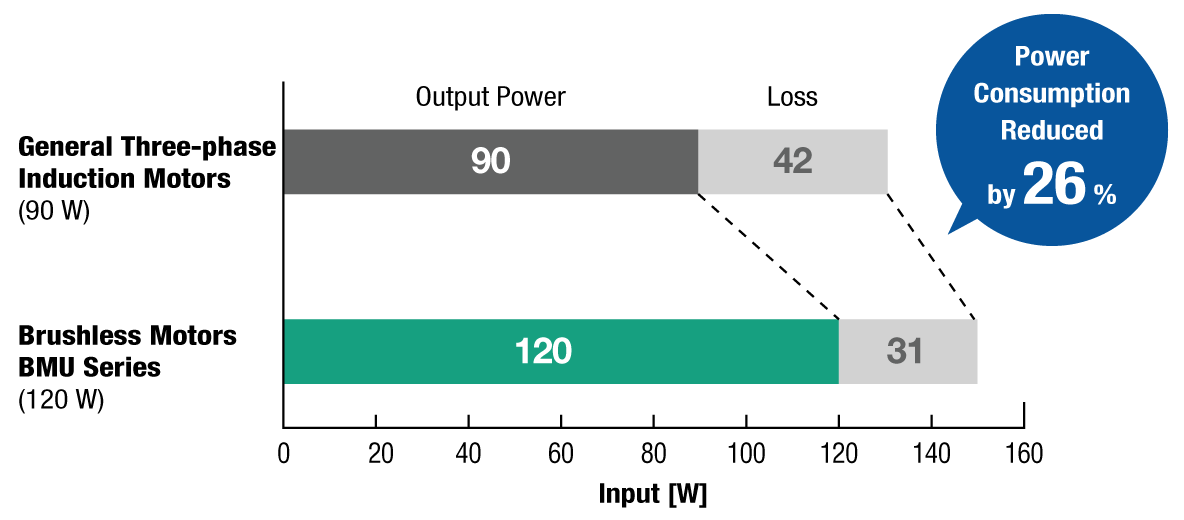
The 120 W output type of the brushless motor BMU Series reduces power consumption by approximately 26% compared to a 90 W three-phase induction motor, contributing to lower overall energy use for the equipment.
Flat and High-power Design Makes for More Compact Equipment
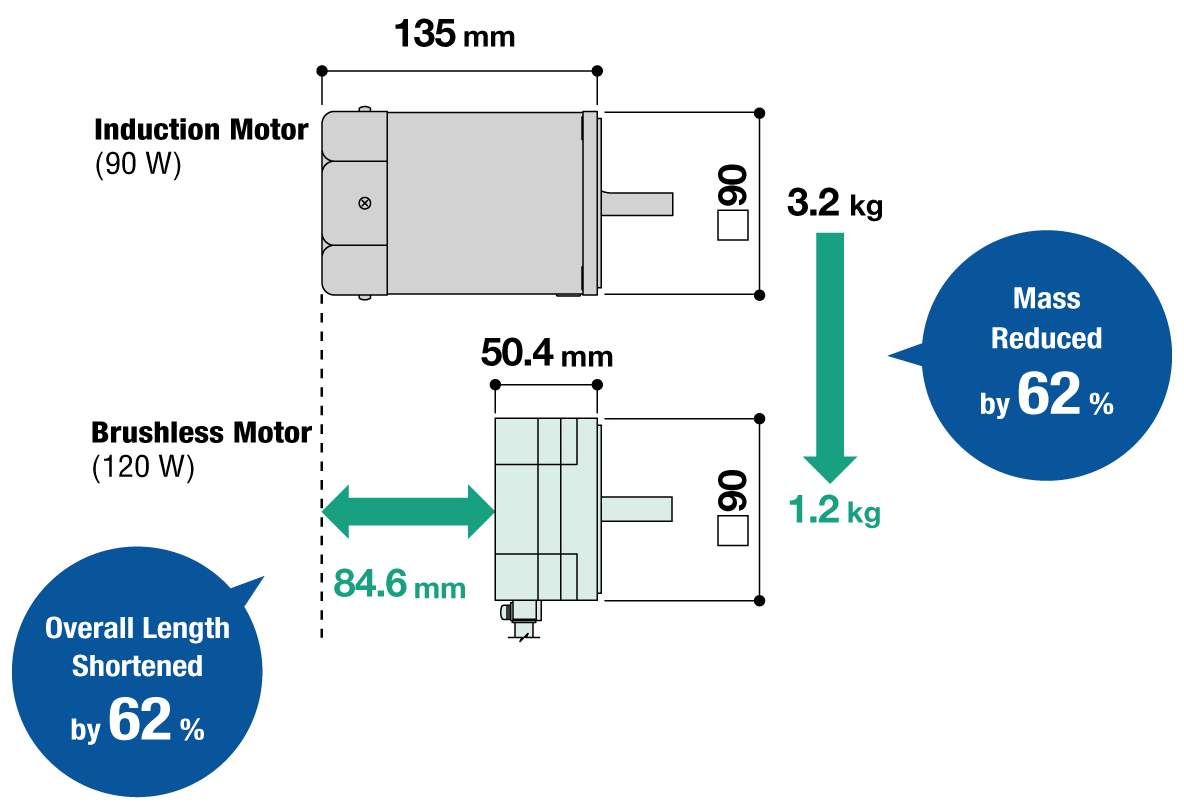
The brushless motor BMU Series are compact while also offering high power. With a 90 mm frame size, the overall length is 84.6 mm shorter than a three-phase induction motor with the same dimensions. Moreover, the output of the brushless motor BMU Series is 120 W, whereas the output of three-phase induction motor is 90 W, meaning output of the brushless motor BMU Series is about 1.3 times higher.
Therefore, the brushless motor BMU Series will help reduce the overall size of the equipment.
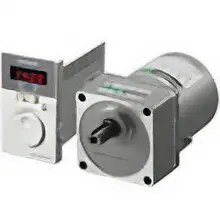
Incidentally, the driver can be easily set to the desired rotation speed by turning the dial, and the rotation speed can be displayed, which is very popular among on site workers.
Proposed Product: Brushless Motor BMU Series
Motor Rated Output Power
- 30 W, 60 W, 120 W, 200 W, 300 W, 400 W
Gearhead Types
- Parallel shaft gearhead
- Right-angle gearhead
- Hollow shaft flat gearhead
In addition to product inquiries, please contact us about any issues you may have, or to request materials and samples.
Technical Manual for Brushless Motors, Useful for Equipment Development, Now Available

For those who handle motors for mass production equipment. Technical explanations of brushless motors such as structures and control principles, as well as the advantages of using the equipment, are compiled in a single volume. This is an essential resource for equipment research, development, and design.