Cooling Fan Specifications
Description of Specification Items
Voltage
Power supply voltage needed to operate the cooling fans.
Frequency
For AC cooling fans, speed varies depending on the frequency. In Japan, frequency is either 50 Hz or 60 Hz.
Current
The current when the cooling fan is at rated speed.
Input Power
The input power when the cooling fan is at rated speed.
Speed
The cooling fan's rated speed.
Maximum Air Flow
Median of the maximum air flow that the cooling fan can produce at rated speed.
(Median value of measurements taken using the double-chamber method.)
Maximum Static Pressure
Median of the maximum static pressure that the cooling fan can produce at rated speed.
(Median value of measurements taken using the double-chamber method.)
Noise Level
Median of the noise level when the cooling fan is at rated speed.
(Median measured in the A-weighted sound pressure level, at a distance of 1 m from the intake side of the cooling fans.)
Capacitance
Capacitor is required to operate single-phase 100 VAC and single-phase 200 VAC cooling fans.
(Capacitor is included or built-in with products.)
How to Read Air Flow - Static Pressure Characteristics Diagrams
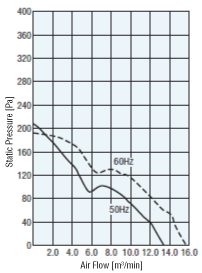
Air Flow - Static Pressure Characteristics Example) MRS Series □200 mm - 90 mm Thick
The air flow - static pressure characteristics diagram indicates the static pressure value for a given air flow, with air flow on the horizontal axis and static pressure on the vertical axis.
In the characteristic on the right, an air flow of 13.2 m3/min (at 50 Hz) corresponds to a condition with no pressure loss (static pressure 0 Pa). This is the maximum air flow value that the cooling fans can produce.
Also, 221 Pa (at 50 Hz) is the maximum static pressure that the cooling fans can produce with the characteristics to the right.
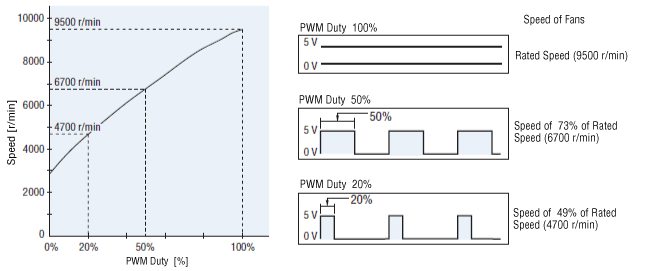
How to View PWM Duty Rotation Speed Characteristics
Example) MDV625-24S